Famous People
 HITLER - A PORTRAIT IN EVIL
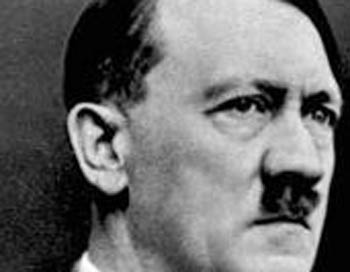 Hitler's bipolar has been well-documented, but what else was going on?
by John McManamy
HITLER - A PORTRAIT IN EVILby John McManamy
WORD TO THE WISE: Be mindful of embracing Beethoven and Michelangelo and Lincoln and Churchill and others as kindred spirits lest you unwittingly include Hitler in the same group hug.
In 1994, D Jablow Hershman and Julian Lieb wrote an extremely controversial work, A Brotherhood of Tyrants: Manic Depression and Absolute Power. that examined Hitler (and Napoleon and Stalin) in the context of bipolar.
According to the authors, Hitler's own personal physician diagnosed him as manic-depressive. As a young man, he attempted suicide. In a manic moment, he made a premature bid for power (the Beer Hall Putsch of 1923), but depression incapacitated him at the crucial hour. His illness fed the delusion that he was Napoleon's worthy heir, and like his idol he too lost an army in North Africa and committed the fatal error of waging a winter campaign in Russia. Unlike his idol, he was no military genius, and his units in the field paid in full measure.
Or Was Hitler a Dug Addict?
But how could a mere mood disorder account for such unspeakable evil? Nassir Ghaemi offers a different explanation. In his 2011 A First-Rate Madness, Dr Ghaemi raises the extraordinary proposition that Hitler was far more "normal" than we give him credit for. According to Ghaemi, evil is not the exclusive domain of people with twisted minds. Perfectly normal individuals, he maintains, are equally as capable of gross inhumanities.
Dr Ghaemi, one of the leading authorities on bipolar disorder, acknowledges that Hitler's depressions and manias are well-documented, but that his condition "seemed manageable," and appeared to benefit him in a way that influenced his rise to power, "fueling his charisma, his resilience, and political creativity."
Then, in 1937, Hitler began treatment with a new personal physician, Theodor Morell, who stayed on till nearly the end. Dr Morell prescribed amphetamines for depression (and a narcotic and other drugs for GI problems and barbiturates for sleep). Confidantes such as Hess and Himmler immediately noted the change in their boss' behavior. In 1941, there is evidence Hitler was taking amphetamines intravenously on a daily basis, supplemented by oral doses. By 1943, he was receiving multiple daily injections.
Dr Ghaemi points out that oral amphetamines cause mania in about half of individuals with bipolar, with a much greater certainty with intravenous injections. Rats are deliberately injected with amphetamines to produce an animal model of psychosis. As thoroughly odious as Hitler had been, Ghaemi observes (citing Bullock), he was a realistic and astute politician. Moreover, he hadn't invaded any countries, nor had he turned genocidal. As Ghaemi describes it: "Morell lit a fuse that exploded the entire world."
We can argue, though, that a year prior to engaging Morell, Hitler was already waging war. In 1936, his armies re-occupied the Rhineland and supported Franco in the Spanish Civil War, then continued their winning streak into Austria and a piece of Czechoslovakia. The fact that Hitler had a powerful military at his disposal in the first place dates to 1933, when he assumed absolute power and immediately put Germany on a war footing.
Clearly, Hitler was primed for war before he engaged Morell as a physician, but yes, we can also make a case that it was Morell who lit the fuse.



Or Was Hitler a Sociopath?
What everyone seems to be missing, of course, is Hitler's obvious sociopathy. Hershman and Lieb are inexcusably silent while Ghaemi gives this diagnosis the quick brush-off:
This condition involves such features as cruelty to animals, breaking the law, and complete absence of empathy. Yet Hitler loved animals, never broke the law before his political activities, and clearly had much empathy for his mother, his childhood friend Kubizek, his half niece Geli, and others.
In a similar fashion, Ghaemi writes off borderline personality disorder and dismisses narcissism as "just a Greek myth."
Barbara Oakley in her 2007 Evil Genes: Why Rome Fell, Hitler Rose, Enron Failed and My Sister Stole My Mother's Boyfriend takes a different approach to personality disorders. Sociopathy is the obvious explanation for Hitler's pathology, she acknowledges, but your garden variety sociopaths are found almost exclusively in the criminal justice system.
What about those occupying the corridors of power in business and government and academia and other realms? These are your classic Machiavellians - charismatic and ruthless - out for themselves at the expense of anyone unfortunate enough to happen to breathe the same air, what Dr Oakley characterizes as the "successfully sinister."
Typically, a range of overlapping personal pathologies come into play. Dr Oakley's "borderpath" poster boy is Chairman Mao - responsible for more than 70 million deaths - who deployed a vast range of psycho/sociopath, borderline, narcissistic, and paranoid traits to his considerable advantage, managing to die in bed at age 82, venerated as a God-figure.
Dr Oakley sees Hitler cut from similar cloth. Her main source is an OSS analysis prepared by a leading Freudian psychoanalyst, Walter Langer, during World War II. Dr Langer's research was exhaustive, totaling 11,000 pages, and from this he created a criminal profile that is still regarded as authoritative.
Langer's Hitler Profile
Dr Langer characterizes Hitler as a "neurotic psychopath." Dr Ghaemi in a footnote takes issue with this diagnosis (his only reference to Langer), though it is clear the label is only a starting point. A quick Google search turned up an excellent piece, Getting Inside Hitler's Head, by military journalist Brian John Murphy, and it is instructive to go off his account ...
As a child, Hitler learned how to manipulate his mother by staging temper tantrums until she caved in. Hitler carried over the same behavior into adulthood. His screaming raging fits were the stuff of legend, and throughout his career he was able to deploy these outbursts to his advantage. His public speeches - an extreme departure from standard German oratory - can be viewed as scripted tantrums that bent the masses to his will.
SIGN UP FOR MY FREE EMAIL NEWSLETTER
His father's death at age 12 appeared to have a lot to do with turning him into an angry young man. Soon after, his performance in school plummeted and later he dropped out. As a down-and-out young man in Vienna, he became a rabid anti-Semite and extreme pan-Germanic xenophobe, unfortunately very "normal" for the time. Soon he found his calling in the trenches on the Western Front.
Hitler's over-the-top taste for war may have resulted in two Iron Crosses, but it also completely spooked his superiors, who vowed never to make him an officer. He failed to bond with his fellow soldiers, and avoided women. His later associations with women were characterized by sexual deviances and callous behavior. Six of his former lady friends attempted suicide. Two succeeded.
After the war, Hitler's bitterness over Germany apparently being sold out by traitors fit right in with the sentiment of the day. In no time, he hit his stride as a political rabble-rouser, deploying his strange charisma, bitter misanthropy, and inexhaustible energy to stunning effect. Along the way, he spied on his socialist-leaning former comrades-in-arms in the trenches, and succeeded in getting some of them hanged.
Exhibit A in Hitler's psychopathy, of course, is Mein Kampf, written in prison following a failed populist uprising where he fired a pistol inside a beer hall. There his pathology is revealed in his own words, not to mention his demented thinking regarding Jews and other non-Aryans. It's all there, except the "final solution," and that can easily be inferred. By the time Hitler completed his blood-stained ascendance to total power as Chancellor in 1933, there was nothing standing in the way. That same year, he spoke with his military leaders about "conquest for Lebensraum" (interpretation: invading Poland). At his first cabinet meeting that year, he prioritized military spending.
Thus, by the time Hitler invaded Poland in 1939, he had a massive and well-equipped army and air force at his disposal, which he had already put to previous use in the Rhineland and Spain and Austria and Czechoslovakia.
According to Murphy's piece:
The Hitler that Langer profiled was a man with a boundlessly grandiose concept of himself. Langer said Hitler believed fate set him apart as a superman, a chosen one, the messiah of a future German empire, who was infallible except for when he had engaged in what he called "the Jewish Christ-creed with its effeminate pity-ethics." When crossed, Hitler wanted retribution that was godlike in its devastation.
Hitler's Delusional Thinking and a Speculative What-If
Dr Oakley in Evil Genes pays considerable attention to delusional thinking, a trait common amongst conspiracy theorists, who are capable of maintaining their crackpot beliefs with great conviction in complete defiance of the facts. Hitler, needless to say, could always rationalize as legitimate his every action, no matter how bizarre and contrary to human nature.
Murphy notes that Langer's analysis was made without reference to Hitler's massive methamphetamine consumption, which only came to light after World War II. Clearly, Hitler's drug cocktail greatly worsened his pathology. According to Murphy:
Witnesses describe the 56-year-old Hitler in 1945 as a shuffling old man wearing a uniform spotted with food and grasping for a handhold every few steps. His left hand trembled violently. Cake crumbs clung to the corners of his mouth. The bags under his eyes were swollen and dark. He drooled. ... By April 1945 he had little left physically or mentally.
This brings us back to Ghaemi's proposition that were it not for the amphetamines, Hitler may well never have invaded Poland.
Perhaps the real question we need to be asking is what if Hitler had pushed ahead with with his irrational ambitions, but in a far more rational and drug-free state of mind? Would he have delayed waging war until say 1942, with an invincible military in place under competent leadership, ready to launch nuclear weapons over the English Channel?
Would the Nazis have actually won the Second World War?
Very scary thought.
See also: Figuring Out Evil
Reviewed July 15, 2016


When I am not writing about mental health, I am out in nature and playing my didgeridoo. This keeps me mentally and physically healthy and socially and spiritually connected.
I've dealt with bipolar pretty much all my life. The early warning signs were there as a child and a teen, growing up with a sense of being different and experiencing crushing depressions. I crashed and burned in college during the early seventies. After several lost years, I resurfaced in New Zealand, where I started a family, obtained a law degree, then embarked on a career as a financial journalist.
Everything came crashing down on me in Australia in the late eighties. It was only much later, back in the States in early 1999, following a series of suicidal depressions, that I finally sought help. With acceptance came healing. Soon after, I reinvented myself as a mental health journalist. Suddenly, my life had a sense of meaning and purpose.
Bipolar still represents a major challenge in my life. Over the years I have learned to accept the fact that I will be more depressed than I would like to be and more animated than those around me would like me to be.
There are days when I would gladly return my brain to the customer service counter of life. But for what purpose? To wake up normal, shorn of my personality?
For better or worse, this is who I am.
NEW!
Follow me on the road. Check out my New Heart, New Start blog.