Famous People
 SYLVIA PLATH - IN HER OOWN WORDS
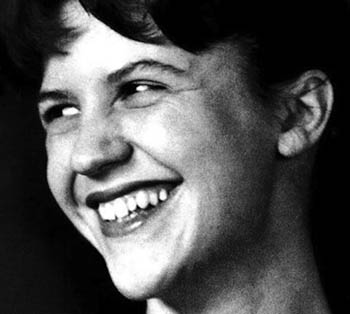
Her own words tell the story.
by John McManamy
SYLVIA PLATH - IN HER OOWN WORDSHer own words tell the story.
by John McManamy
IT WAS a bitter cold winter in 1963, and an American mother of two was doing her best to cope on her own in London, not long after being jilted by her husband for another woman. Poet Sylvia Plath, 30, left out bread and milk for her two toddlers sleeping in an upstairs bedroom.
Then she turned on the gas.
Following the posthumous publication of her Ariel poems, Sylvia Plath became a feminist cause celebre, with ex-husband poet Ted Hughes vilified as an accomplice to her death. Completely overlooked by these critics, however, was Exhibit A, the writer's very own words, her semi-autobiographical novel, "The Bell Jar."
Check out this description of her shock treatment:
... with each flash a great jolt drubbed me till I thought my bones would break and the sap fly out of me like a split plant.
The book also recounted her attempted suicide at age 20, not to mention her morbid preoccupation with death. The Bell Jar was a metaphor for the feelings of hopelessness and despair and self-contempt she carried with her everywhere:
How did I know that someday - at college, in Europe, somewhere, anywhere - the bell jar, with it's stifling distortions, wouldn't descend again?
Make no mistake, this book is THE depression memoir, published out of time in an age of neurosis. Her Journals, published in full for the first time in the early 2000s, shed far more light. According to an article in the Guardian:
"It is here in her diaries that Plath reveals what she really thinks - about her depression, about her sexuality and about Hughes."
In an early entry, she reveals her manic as well as depressive side:
God, is this all it is, the ricocheting down the corridor of laughter and tears? Of self-worship and self-loathing? Of glory and disgust?
And again:
It is as if my life were magically run by two electric currents: joyous and positive and despairing negative; whichever is running at the moment dominates my life, floods it. I am now flooded with despair, almost hysteria, as if I were smothering.
On the day after she met Ted Hughes, she wrote a poem "about the dark forces of lust." Entitled "Pursuit," it begins: "There is a panther stalks me down:/One day I'll have my death of him."
But first came the grim foretelling of her suicide attempt at age 20. In November 1952, she wrote:
God, if ever I have come close to wanting to commit suicide, it is now, with the groggy sleepless blood dragging through my veins, and the air thick and gray with rain and the damn little men across the street pounding on the roof with picks and axes and chisels, and the acrid hellish stench of tar ... My world falls apart, crumbles, 'The centre does not hold.' There is no integrating force, only the naked fear, the urge of self-preservation.
With a wisdom way beyond her years, she notes:
I am afraid, I am not solid, but hollow. I feel behind my eyes a numb, paralysed cavern, a pit of hell, a mimicking nothingness, I never thought, I never wrote, I never suffered. I want to kill myself, to escape from responsibility, to crawl back abjectly into the womb. I do not know who I am, where I am going - and I am the one who has to decide the answers to these hideous questions. I long for a noble escape from freedom - I am weak, tired, in revolt from the strong constructive humanitarian faith which presupposes a healthy, active intellect and will. There is nowhere to go - not home, where I would blubber and cry, a grotesque fool, into my mother's skirts - not to men where I want more than the stern, final, paternal directive - not to church which is liberal, free - no, I turn wearily to the totalitarian dictatorship where I am absolved of all personal responsibility and can sacrifice myself in a "splurge of altruism" on the altar of the Cause with a capital "C".
SIGN UP FOR MY FREE EMAIL NEWSLETTER
But the Journals also reveal a very much alive side to the poet, whose run-on writing shimmers with a bebop sense of fifties hip we normally associate with the likes of Kerouac and company:
Falcons Yard, and the syncopated strut of a piano upstairs, and oh it was very Bohemian, with boys in turtle-neck sweaters and girls being blue-eye-lidded or elegant in black. Derrek was there, with guitar, and Bert was looking shining and proud as if he had just delivered five babies, said something obvious about having drunk a lot ... By this time I had spilled one drink, partly into my mouth, partly over my hands and the floor, and the jazz was beginning to get under my skin, and I started dancing with Luke and knew I was very bad, having crossed the river and banged into the trees, yelling about the poems, and he only smiling with the far-off look of a cretin satan. He wrote those things, and he was slobbing around. Well, I was slobbing around, blub, maundering and I didn't even have the excuse of having written those things; I suppose if you can write sestinas which bam crash through lines and rules after having raped them to the purpose, then you can be satanic and smile like a cretin beelzebub.
Hours later, she wrote her "Pursuit" poem, dedicated to Ted, and later "Lady Lazarus," where she boasted:
I rise with my red hair/And I eat men like air
In a sense, Sylvia Plath has been restored to life, by the power of her own pen, by the power of her own words. That such a vital force was struck down by depression makes her short life all the more tragic. But her own words also portray triumph, of a woman who overcame tremendous odds just to find some joy in her life, a joy she was able to manifest in full measure.
Reviewed July 15, 2016
NEW!
Follow me on the road. Check out my New Heart, New Start blog.





MORE ARTICLES ON McMAN






FEATURED VIDEOS