Stories
 ALONE, AGAINST THE WORLD
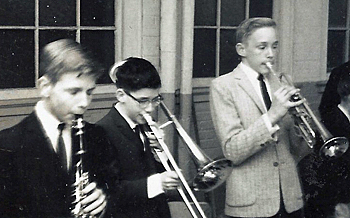 A small skinny kid learns to cope.
by John McManamy
ALONE, AGAINST THE WORLDby John McManamy
IT WAS ME, alone, against the world. There was no other way to describe it. It was around age 11 and 12 when I noticed that I was a lot shorter and skinnier than the kids my age. Then they all started sprouting hair in funny places and talking in deep voices in knowing ways, and the realization struck with Biblical force:
My God! I really was different!
It was like those dreams everyone seems to have of turning up in public in just your underwear. If only it were just that. If only the shame and embarrassment were for just one day. If only I could just go home and reach in the closet and slip into my leg and pubic hair the way I could a pair of pants and grow six inches and return to school and blend in and say things like, eat it raw, like I really knew what I was talking about.
No, I was doomed to show up for school in the equivalent of my dream underwear every day for the next three years.
My inner immune system invented its own respite from the terror of school and the outside world. Just when I knew I could not ever possibly board that school bus one more time, my body would give out on me. My throat would constrict and flare up, my nose would heave up great gobs of green bloody snots, and I would cough the cough of the dead.
Then the healing would start. There in bed, or on the couch under a million blankets shivering in a sweat-induced micro-climate of Vicks Vapo-rub fumes, my strength would come back. Slowly. Over several days, a week, more. Then one day I would get out of bed and get dressed, too far behind in my school work to ever really catch up, but nevertheless ready to take what the day offered, one day at a time.
It was in one of these states of suspended animation that I found myself gulping down chicken soup and watching John Glenn's tickertape parade in New York. I felt a warm thrill flow through all eighty or so pounds of me. To see the earth as only God and a handful of men had ever seen it - one day it would be me. I still had the power to dream.
It didn't take me long to flunk out of the astronaut program. The only thing that I was ever good in, it turned out, was dodge ball. Prisoner's dodge, wall dodge, circle dodge, no one could get me out, not even the older kids. This was my true gift. Had dodge ball been a major sport, I would have been offered a full scholarship to Notre Dame and been a first round draft pick in the World Dodgeball League.
Unfortunately, no one played dodge ball after sixth grade, and with all the other sports I was always the last one picked. Nevertheless, when I hear the experts speak of a God-given talent, I know what they are talking about. I know what near-perfection is, because in one small inconsequential realm of human activity at age nine and ten I had experienced it.
Oddly enough, my gift for dodge ball would have made me astronaut material, for I undoubtedly had the reflexes of a Jedi master. Just throw a ball at me and I'll prove it to you. The catch was all this unrecognized talent in an all too frail body with bad eyes and a maturity meter set to low. Perhaps it was God's idea of a joke.
It was around this time I discovered classical music, Tchaikovsky in particular and his Pathetique Symphony. Just as Elvis once lifted me into a different place, I now found myself in a different place again, but a very different kind of different place. I would hear three trombones in my head, big broad fat notes that took four large men to pick up and carry, and knew I had stumbled into the inner rumblings of the mind of God.






It seems besides granting me Jedi master's reflexes, God also endowed me with a musician's soul, but one, oddly enough, not connected to my Jedi reflexes. I started on the trumpet in fourth grade, and could have played it well into high school with no one really noticing or caring how bad I was, but then fate stepped in.
I switched to trombone in seventh grade and by eighth grade I was the only one, more or less, left standing. Like a war of attrition. All the other trombones, it seems, had been taken out. It was just me. And this was the year the band director decided to form a dixieland band.
To give you an idea of the company I now found myself in, one of the members of this little ensemble joined the Orpheus Chamber Orchestra, another the Saturday Night Live band, and the others were good enough to give it a shot. Another would graduate from an Ivy League school and the rest weren't far behind.
Then there was me.
The tenor sax in the group, the one who went on to the Ivy League, came over to me one day, grinning. "If you were my dog," he said to me, "I'd shave your ass and make you walk backward."
One day, at practice in one of their houses, they all charged me at once and spread-eagled me in the air. Once they saw the terror on my face, they laughed and put me down, satisfied at their fun.
SIGN UP FOR MY FREE EMAIL NEWSLETTER
That summer we had an outdoor gig in the city park. We were part of a band concert, one of those Sousa type bands where the members had union cards. There must have been upwards of a thousand out on the park lawn, spread out on blankets or sitting in folding chairs, many with picnic dinners, all in a holiday mood. The Sousa band did their numbers, then it was our turn.
The clarinet player who was the leader of the group gave me the evil eye, as if to say you screw up here and you're a dead man. I walked out onto the outdoor stage like I was going to the gallows, trombone in one hand, music stand in the other - four sheets of music clipped on with clothespins - praying to God we wouldn't have to do an encore, because that fourth piece to me was as decipherable as the Rosetta Stone.

The clarinet player counted off and - bang! - we were into the first piece. It went off without a hitch, and by the second number the crowd was getting into it. Then came the third number, which featured written solos from everyone in the group, me included. I reached way down low on the slide and hoped lightning wouldn't strike me dead.
Or maybe I wished it would - I can't remember.
We wrapped up the song and the crowd was on its feet, cheering and stamping wildly. My God! I could only think. There's going to be an encore! And here I was with the Rosetta Stone clipped to my music stand.
I'll just move my slide and pretend I'm playing, I thought. And that's sort of what I did. I tuned out the people on the lawn in front and the Sousa band behind and pointed my trombone down to the ground, hoping to turn invisible.
There was really only one note I had to hit, and that was when the piece changed key. My job was to reach out practically to the end of the slide and belt out a low C. So up went the trombone and out came the C right on schedule. Back down to the ground I went.
Mercifully, it ended. I looked up and the people out on the lawn were back on their feet. Then I looked back at the Sousa band and THEY were on their feet. A standing ovation from the house band. Let me put this into perspective: More people have walked on the moon than have received a standing ovation from the house band.
Once off stage, my fellow tormentors actually congratulated me. Enthusiastically, at that. Then it sunk in: I had nailed my first three pieces. Not only that, my fake slide work on the fourth number had been mistaken for real jazz, not just kiddie band dixieland. This is why all those musicians with union cards behind us were on their feet applauding. It was because of me!
All four feet eleven and ninety pounds of me.
I had outplayed the others by a country mile, and the Ivy League tenor sax player and all the others were ecstatic. I had broken through. I was one of them. For one brief shining moment I was accepted.
But not for what I was. You see, right after that I went right back to not being able to play my trombone worth shit. Once more I was the butt of their jokes, the object of their gossip, the source of their malicious amusement. I was right back to where I had been before, me, alone, against the world.
NEW!
Follow me on the road. Check out my New Heart, New Start blog.